Elevate Your Brand Presentation with a Professional Envelope 3D Mockup
In the competitive landscape of modern branding, the first physical touchpoint a client has with your business often determines the trajectory of your relationship. Whether it is a wedding invitation, a corporate proposal, or a direct mail marketing campaign, the envelope serves as the gateway to your message. However, presenting these designs to stakeholders or clients using flat, two-dimensional images often fails to capture the tactile quality and professional polish of the final product. This is where utilizing a high-quality Envelope 3D Mockup becomes an essential strategy for designers, marketers, and business owners alike. By transforming static layouts into realistic, three-dimensional presentations, you bridge the gap between digital concepts and physical reality, ensuring your vision is understood and appreciated before a single sheet of paper is printed.
The Challenge of Visualizing Physical Stationery
Designers and brand managers frequently face a significant hurdle when showcasing stationery projects: the inability to convey texture, depth, and lighting through standard screen displays. When you present a flat JPEG of an envelope design, you lose critical visual cues. The recipient cannot see how the light catches the grain of the paper, how the folds create subtle shadows, or how the overall composition sits in a real-world environment. This lack of context can lead to misinterpretation, where a client might approve a design that looks good on screen but feels cheap or unbalanced in print.
Furthermore, creating custom photography for every iteration of a design is prohibitively expensive and time-consuming. Hiring a photographer, sourcing props, arranging lighting, and editing photos for each variation of a mailing piece is simply not scalable for most agencies or freelancers. The goal is to achieve a photorealistic presentation that instills confidence in the client without the logistical nightmare of a full-scale photoshoot. An Envelope 3D Mockup solves this by providing a pre-lit, textured, and perfectly angled canvas where your design can shine immediately.
How Realistic Mockups Transform Client Presentations
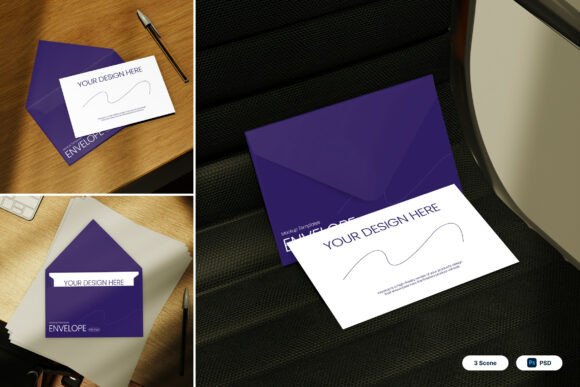
The primary value of integrating an Envelope 3D Mockup into your workflow lies in its ability to simulate reality with stunning accuracy. These tools are designed with natural lighting and detailed envelope folds that enhance the perception of quality. When a client sees their logo embossed on a textured surface with realistic shadows cast by the flap, they are no longer looking at a graphic file; they are visualizing the finished product. This psychological shift is powerful. It moves the conversation from "Does this pixel alignment look right?" to "How does this make our brand feel?"
High-resolution mockups, typically offering sizes like 4000 x 3000 pixels at 300 DPI, ensure that every detail is crisp. This level of fidelity is crucial for print-ready presentations. It allows you to zoom in on specific elements, such as the seam of the envelope or the texture of the paper stock, demonstrating attention to detail that builds trust. By using a mockup that features clean stationery layouts and professional mailing presentation scenes, you position your work within a context of elegance and professionalism, subtly influencing the client's perception of value.
Practical Applications Across Industries
The versatility of an Envelope 3D Mockup extends far beyond simple correspondence. Different industries leverage these tools to meet specific branding needs:
- Wedding and Event Planning: For invitation designers, the envelope is just as important as the card inside. A mockup allows couples to visualize the entire suite, seeing how the calligraphy on the front complements the liner inside. Multiple viewing angles help showcase the depth of the pocket fold or the elegance of a wax seal placement.
- Corporate Identity: Businesses sending out proposals, contracts, or welcome kits need to project authority. A realistic mockup of a branded business envelope suggests a level of polish that implies the documents inside are equally well-crafted. It reinforces corporate identity showcases by maintaining consistent visual standards across all touchpoints.
- Direct Mail Marketing: In an era of digital saturation, physical mail stands out. Marketers use mockups to test different design variations for campaigns. By placing different headlines or color schemes onto the same realistic envelope template, teams can decide which version offers the highest potential for engagement before committing to a print run.
Streamlining Workflow with Smart Object Technology
One of the most practical aspects of modern mockup resources is the integration of smart object layers. For users who may not be Photoshop experts, this feature is a game-changer. The process is incredibly straightforward: you simply double-click the designated layer, place your flat design file, save, and the software automatically wraps your artwork around the 3D form. This automation handles the complex warping, shading, and blending modes required to make the design look native to the envelope surface.
This efficiency allows designers to iterate rapidly. If a client requests a color change or a logo adjustment, you can update the mockup in seconds rather than hours. Most comprehensive packages include multiple PSD files, offering various angles and scenes. This variety ensures that you are not stuck with a single perspective. You can present a front view, a back view with postage, or an open view showing the contents, providing a holistic look at the project. Additionally, the inclusion of a PDF help guide ensures that even novice users can navigate the file structure confidently, maximizing the utility of the resource.
Considerations for Effective Implementation
While the tool itself is powerful, the outcome depends on how it is used. To get the most out of an Envelope 3D Mockup, consider the following recommendations:
- Match the Paper Texture to Your Intent: Although the mockup provides a base texture, ensure your original design file accounts for the material you intend to print on. If the mockup simulates a rough kraft paper, a design with fine, delicate lines might get lost. Adjust your contrast and saturation in the source file to compensate for the simulated lighting.
- Context Matters: Choose a scene that matches your brand voice. A stark, minimalist envelope on a white background suits a tech startup, while a warm, wooden desk setting with natural light better serves an artisanal bakery or wedding planner. The environment tells a story about who the brand is.
- Resolution is Key: Always work with high-resolution assets. Using a low-res image in a high-res mockup will result in pixelation that ruins the illusion of realism. Ensure your source artwork is at least 300 DPI to match the 4000 x 3000 pixel canvas of the mockup.
- Lighting Consistency: Pay attention to the direction of light in the mockup scene. If your design includes elements that would theoretically cast shadows (like thick foil stamping), try to align them with the existing light source in the 3D scene for maximum believability.
Tailoring the Approach for Different Users
Different professionals will approach the Envelope 3D Mockup with unique goals. A freelance graphic designer might use it primarily for portfolio enhancement, creating stunning case studies that attract higher-paying clients. For them, the aesthetic quality and the "wow" factor are paramount. On the other hand, an in-house marketing manager might prioritize speed and consistency, using the mockup to quickly generate assets for internal approvals or social media teasers. Meanwhile, a print shop owner could use these files as a sales tool, showing customers exactly how their chosen paper stock will look once printed, thereby reducing hesitation and accelerating the sales cycle.
Regardless of the specific role, the underlying need remains the same: the desire to communicate quality and clarity. By leveraging a tool that offers realistic paper textures, clean layouts, and professional presentation scenes, you eliminate ambiguity. You provide a visual proof of concept that aligns expectations and elevates the perceived value of your work.
Conclusion
In a world where visual communication is paramount, settling for flat, lifeless presentations is a missed opportunity. An Envelope 3D Mockup is more than just a design accessory; it is a strategic asset that enhances branding, clarifies communication, and streamlines the approval process. By adopting these high-resolution, easy-to-use resources, you empower yourself to present ideas with the confidence and professionalism they deserve. Whether you are crafting an invitation that marks a once-in-a-lifetime event or designing the corporate correspondence that defines a business, the right presentation makes all the difference. Embrace the depth, texture, and realism that only a quality 3D mockup can provide, and watch as your stationary designs transition from simple files to tangible experiences.